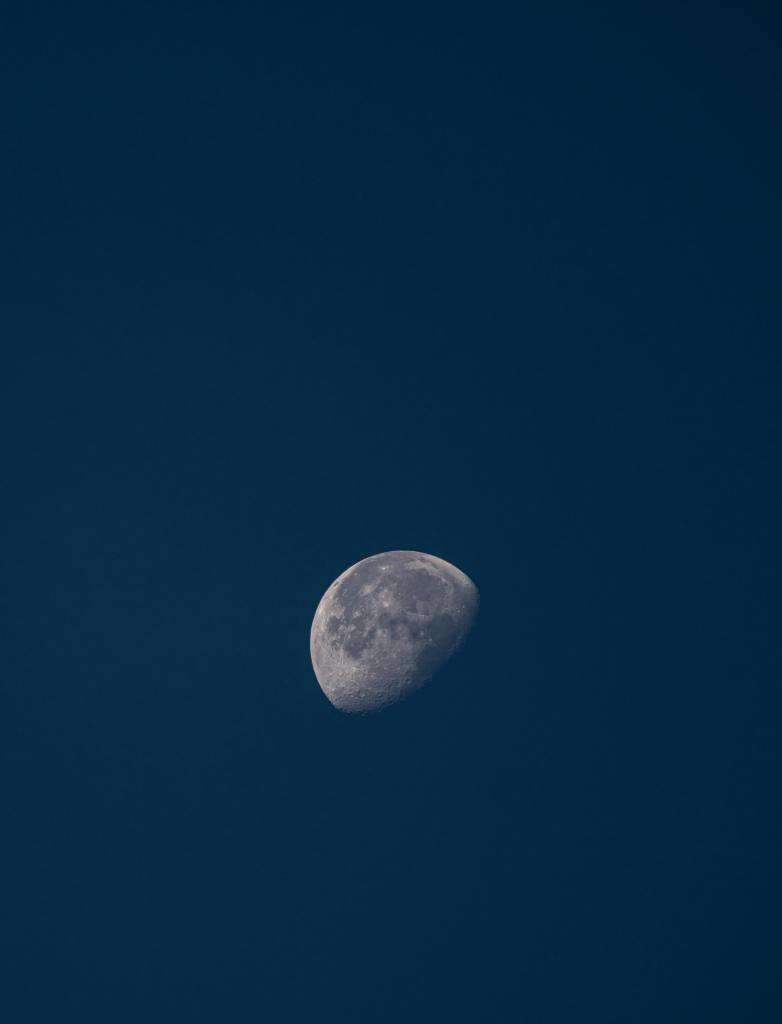
My daughter was the first person to show me an appreciation for the moon. From the young age of two, I can still picture her sitting in her little pink Barbie Jeep, pointing up one evening and saying, “the moon, the moon.” From that moment on, she wanted to stay up late for every supermoon, every red moon and any excuse to look up at the sky.
In recent years, I’ve found myself paying closer attention too. I notice its position in the sky, how it seems to appear in a different place, how some nights it rises later than others as the month goes on. It amazes me every time. It’s a quiet reminder that this world is always moving, always shifting, even when things feel still. The vastness, the order, the mystery of it all—the greatness of the universe is really something else.
Recently, that curiosity deepened as I’ve been following the mission of the NASA spacecraft Artemis II. I think I may have missed my calling back in high school to fully geek out about these kinds of things—but remember, I was too busy trying to people-please and fit in.
What intrigued me most is that their mission will take them around the moon. And what’s even more interesting is something I only learned recently: because of a phenomenon called tidal locking, the moon rotates at the same speed that it orbits the Earth. That means the same face of the moon is always turned toward us.
We’ve all heard the phrase “the dark side of the moon.” Someone should probably tell Pink Floyd that the moon doesn’t actually have a dark side. It has a far side.
But I digress—this page isn’t meant to be educational.
The side of the moon we see is familiar; cratered, glowing, dependable. The far side still gets sunlight, still exists fully, but it remains hidden from our view.
And honestly? That feels like a perfect metaphor for people.
We walk through the world seeing only the side others choose—or are able—to show us. The “good side.” The polite, capable, smiling, functioning, I’ve-got-this side. From the outside, everything can look calm, together, even bright. I can’t tell you the amount of times I thought someone had their shit together only to discover that they’ve struggled, messed up or questioned themselves just as much as I have.
There is always another side.
A side shaped by quiet fears, exhaustion, grief, anxiety, or pressure that never makes it into casual conversation. A side that still feels the full force of life, just not where others can easily see it.
The far side of the moon isn’t broken or damaged because we don’t see it. It’s simply turned away. And people are often the same. Just because someone shows up, gets things done, laughs, or looks strong doesn’t mean they aren’t carrying something heavy.
This is why kindness matters more than we think.
You never know what someone is managing behind the scenes—what they’re holding together with sheer will, what they’re processing in silence, what they’re surviving while still showing up for everyone else. Even the people who seem the most “together” may be running on fumes.
It’s also a reminder for ourselves.
We don’t owe the world constant brightness. We are allowed to have a far side too. A place where we rest, feel, struggle, and heal without explanation. Showing only one side doesn’t make us dishonest—it makes us human.
The moon doesn’t apologize for being partially unseen. It doesn’t try to rotate faster to prove itself. It simply exists, whole and complete, even when only part of it is visible.
Because everyone has a far side—and it deserves understanding, not judgment.
When I think back to my two-year-old in her pink Barbie Jeep, pointing up with such certainty and wonder, I realize she wasn’t analyzing phases or orbital patterns. She was just noticing something bigger than herself.
Maybe that’s the invitation.
To look up more, assume less and remember that everyone — including ourselves — is whole, even when only part of us is visible.
The moon never needed to show its entire face to be complete.
Neither do we.
 The Other Side of Nice